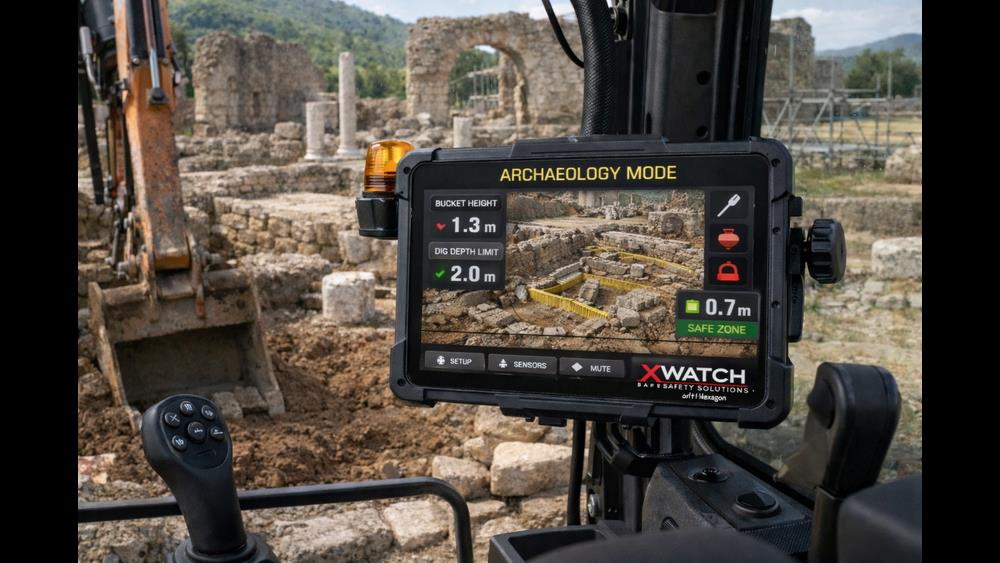
Telematics mavens, Xwatch Safety Solutions, is introducing a new product designed for increasingly sensitive jobsites, archeological digs, infrastructure projects, and that sort of thing.
The tantalisingly titled '5D Ground Intelligence' (with 'Archaeo Assist'), the system has been trialled on a 15-tonne machine - with archaeologist excavator operators trained to use the new technology.
Major UK infrastructure schemes highlight scale of archaeological activity required ahead of construction, with excavations already underway across Essex and Kent. Around Coalhouse Fort in East Tilbury, archaeologists are currently uncovering and recording historical remains, with further investigations planned along the route in the coming months.
Using onboard sensing combined with telematics, the 5D system monitors ground interaction during excavation, logging and geo-tagging detections in real-time. Operators receive live in-cab alerts when metallic objects, utilities or unknown obstructions are identified - the Archaeo Assist function then generateing a predictive reconstruction of the object, including estimated age, origin and cultural relevance.
Early demonstrations have already recorded a number of high-interest detections, including a small metallic object provisionally identified as a Roman coin, several linear features believed to correspond with historic wall structures, and what has been described internally as a suspiciously well-preserved chalice of unclear origin.
One controlled trial site, currently undisclosed due to ongoing works, has produced additional anomalies that, according to early, unverified classification data, may correspond to historical references linked to the so-called Holy Grail. Well, you never know...
On another occasion, the system temporarily paused excavation after detecting what it classified as non-native coconut shells of possible Arthurian relevance, prompting the operator to manually override the system.
Jemma Dycer Hopkins, Sales and Operations Manager at Xwatch, said: “Our R&D is always driven by what’s happening on site. We already support underground detection alongside our height, slew and RCI systems, but what we’re seeing on major projects now — particularly where archaeology is involved — is a need to go further. This is about giving machines the ability to interpret what they’re interacting with in real time.”
https://xwatch.co.uk/