PASMA’s ‘Knowledge Academy’ offers free, flexible training for its members, but awareness and uptake remain stubbornly low. Council member Martin Doran explains why that needs to change and what the industry is missing.
For an industry built on safety, standards and competence, it is perhaps surprising that one of its most accessible training resources remains underused. That, at least, is the frustration of Martin Doran, general manager of Astley Hire and a serving council member of PASMA, the trade body for mobile access towers.
At the centre of the issue is PASMA’s Knowledge Academy – an online training platform designed specifically for hire companies and their staff. Despite being included as part of PASMA membership, Martin believes it is still far from common knowledge, let alone widely adopted.
“We’ve got what we think is a really good product,” he explains, “but it’s about making sure the right people know it exists – and understand that it’s there for them to use.”
The problem, as Martin sees it, is not the quality of the training, but the knowledge of its existence within the marketplace. Historically, PASMA has been more closely aligned with manufactures and training centres, meaning its messaging often reaches these parts of the business, rather than the staff who work in the equipment hire or sales function, who would benefit most from the bespoke training courses.
That is a missed opportunity, because the Knowledge Academy is deliberately designed with such roles in mind. The courses are short – typically around 30 minutes – online, and flexible enough to be completed around the working day. More importantly, they are tailored specifically to the realities of hire operations.
“We’ve taken the existing PASMA training and broken it down,” Martin adds. “We’ve focused on what hire companies actually need to know – things like inspection, maintenance, loading, and understanding customer requirements.”
This distinction is key. Traditional PASMA courses, such as Towers for Users, are aimed at end users – those assembling and working from the equipment. In contrast, the Knowledge Academy shifts the focus to the hire process itself: how equipment is checked in and out, how damage is identified, and how staff ensure the right kit is supplied for the job.
In an industry where human judgement remains central, that knowledge gap can have real consequences. Hire staff are often the first, and sometimes the only point of contact for customers seeking advice. If they lack confidence or understanding, the risk of misuse increases.
“Depending on who picks up the phone, the level of knowledge can vary,” Martin notes. “But they’re the ones advising customers, checking equipment and making sure everything is safe.”
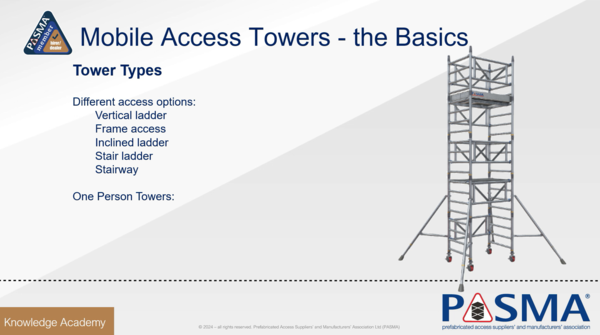
The Knowledge Academy aims to standardise that baseline. It begins with four foundation courses which are compulsory for every individual, Martin likens to “building the base of the house”, before progressing to more advanced, role-specific modules. Not every employee needs to complete the advance courses, but the structure allows companies to tailor training to align with those individual responsibilities within the business.
Crucially, the barrier to entry is not cost. The training is included within PASMA membership, with no limit on the number of staff who can enrol. The only real investment required is time – something that Martin acknowledges can be a challenge in busy hire environments.
Still, he argues that the format is designed to minimise disruption. “You’re not taking someone out of the business for a full day,” he says. “It’s half an hour here and there—something that can fit around workloads.”
For smaller hire companies in particular – those without dedicated training departments – the value proposition is clear: structured, industry-specific training at no additional cost.
So why isn’t it being used more widely?
In Martin’s view, it comes back to visibility. PASMA’s traditional communication channels, such as newsletters, may not reach the people who need them most. To address this, he believes the message must be amplified through other industry voices – trade media, forums and influencers within the hire sector.
“It’s about raising awareness,” he says. “People need to know it’s there. Once they do, it’s a bit of a no-brainer.”
There is also a cultural element. Some companies may still favour traditional, in-person training, or simply default to established practices. But as the industry evolves, and as pressures on time and cost increase, digital, bite-sized learning is likely to play a growing role.
For Martin, the goal is straightforward: to see the Knowledge Academy become a standard part of training across the hire sector, improving consistency, competence and ultimately safety.
“We’ve put a lot of work into it,” he says. “Now it’s about getting people to use it – and benefit from it!”
https://pasma.co.uk/