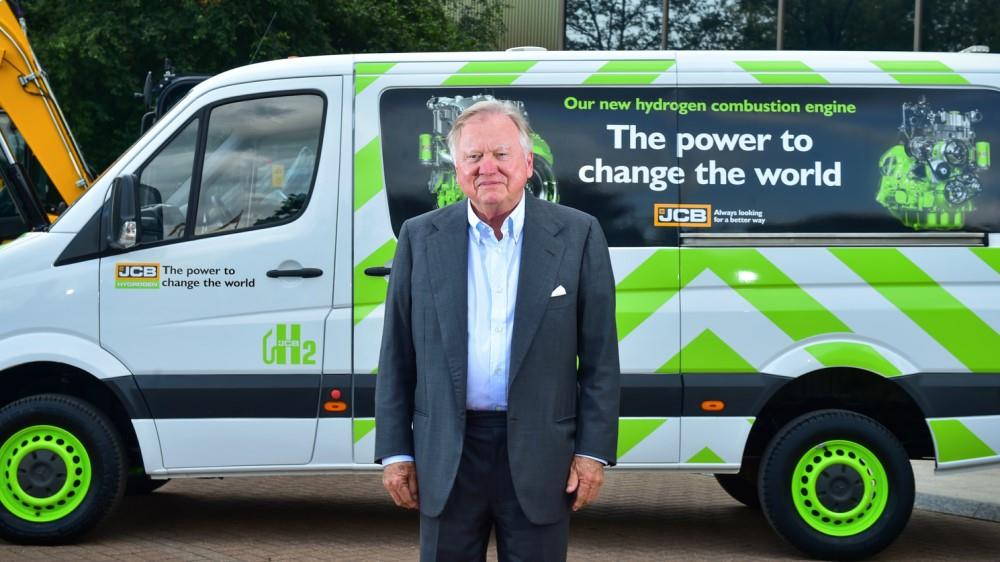
Strike that - better make it White Van Person. Either way, JCB has just retrofitted a Mercedes Sprinter van with one of its hydrogen engines, thus proving the adaptability and scalability of the technology.
The internal combustion engine used in the van is the same as those already powering prototype JCB construction and agricultural machines. It is the second Mercedes vehicle to be retrofitted with a JCB hydrogen engine - earlier this year a 7.5 tonne Mercedes truck was given the hydrogen treatment.
“We have retrofitted this vehicle with a JCB hydrogen engine to demonstrate how simple it will be to convert existing vans and to show that it is not only construction and agricultural machines that can be powered by hydrogen. While converting vans will not be for JCB to do, it does prove there is something else other than batteries that can work very effectively,” explained Lord Bamford.
JCB has already manufactured over 70 hydrogen internal combustion engines in a project involving 150 British engineers, and they now power prototype JCB backhoe loader and Loadall telescopic handler machines. The converted van was formerly diesel-powered and the switch to hydrogen is another breakthrough which underlines that this form of power could represent a much quicker way to reach global carbon dioxide emissions targets. Hydrogen-powered vehicles can also be refuelled in a matter of minutes - much akin to domestic refuelling, in fact, and certainly hours faster than recharging battery-powered machines.
Last year JCB revealed another industry first – a mobile hydrogen refueller which provides a quick way to refuel machines on site.