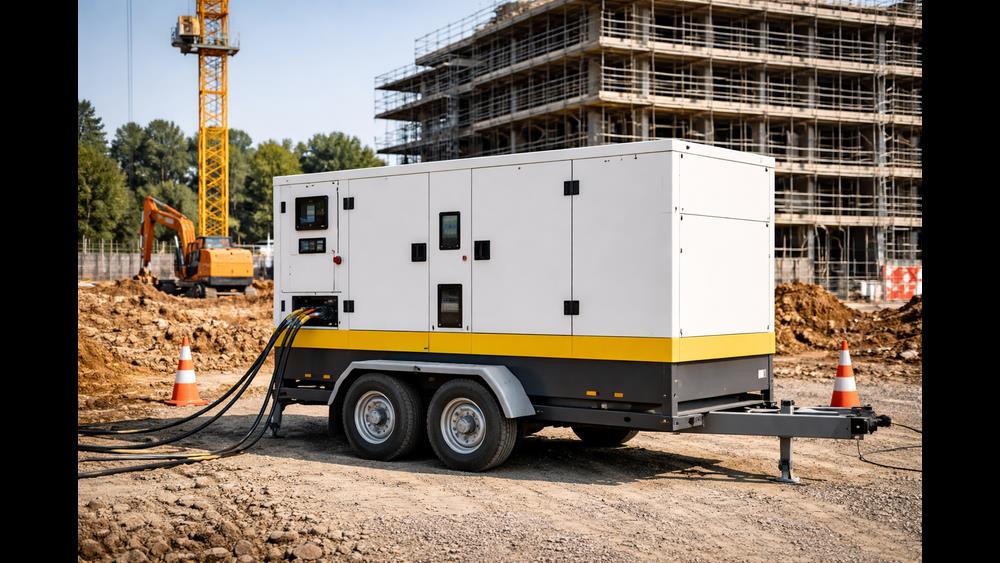
A recent press trip highlighted the issues and side-effects of over-specifying generators. It isn’t about going bigger - it’s about getting it right. This quick guide explains how to avoid costly oversizing and ensure every generator works efficiently for the job at hand.
Hiring a power generator is often treated as a quick, practical decision - pick something large enough and move on. Yet across the industry, that instinct has created a quiet but costly problem. Generators are frequently oversized, with some estimates suggesting they typically operate at just 15% of their capacity. That gap between what’s needed and what’s supplied translates directly into wasted fuel, unnecessary expense and inefficient performance.
For hire companies and customers alike, the goal should not be ‘more power’, but ‘the right power.’ Getting there is simpler than it sounds, provided you understand a few key ideas.
Start with what you need to power
Every good decision begins with a clear picture of demand. Before thinking about generator sizes, focus on the equipment. What exactly needs to run?
Listing all tools, machinery, lighting and site units gives you a baseline. Each item has a power requirement, and when combined, these figures reveal the true level of demand. What’s often overlooked is that some equipment needs extra power when it starts. That short burst can be significantly higher than normal running levels and it must be allowed for. In other words, you are planning for how equipment behaves in reality, not just what it says on paper.
Understanding kW, kVA and why it matters
Most equipment lists its power in kilowatts (kW). This is the useful working power - the energy that actually does the job. Generators, however, are usually rated in kilovolt-amps (kVA). This reflects the total power available in the system, including some that is lost in the process of delivering useful work.
The link between the two is something called the ‘power factor’, which is essentially a measure of efficiency. In simple terms, it describes how much of the generator’s total output is converted into useful power. For most generators, a typical power factor is 0.8. That means only 80% of the generator’s rated capacity is doing useful work.
So, if your equipment requires 100kW, you cannot simply choose a 100kVA generator. In practice, you divide the required kW by the power factor to find the appropriate generator size. That same 100kW demand would need roughly a 125kVA generator. This is not about complex maths, but about recognising that the generator needs to supply a bit more than the headline demand to account for real-world inefficiencies.
Size matters
An oversized generator rarely operates efficiently. Instead of working within its optimal range, it idles along, consuming fuel without delivering proportional output. Over time, this not only increases costs but can also lead to mechanical issues associated with low-load running – ‘wet-stacking’, as it’s known when unburned fuel and soot build up due to operating at low loads.
That widely cited figure of generators running at around 15% load is not just a statistic - it is a reflection of this mindset. Bigger is not safer if it means persistent inefficiency.
Allow a sensible safety margin
Avoiding oversizing doesn’t mean cutting things too fine. A well-chosen generator still needs room to breathe.
Generators are not designed to run at full capacity continuously, so building in a modest buffer helps accommodate fluctuations, start-up demands and the unexpected. A margin also allows for small changes on site, such as adding equipment later. The key is balance - a generator should feel comfortably capable, not excessively oversized.
Understand how the generator will be used
Context matters as much as calculation. A generator used occasionally as a backup behaves very differently from one that powers a site all day, every day.
Continuous use places greater emphasis on efficiency and correct sizing. Running a generator well below its intended load for long periods can be just as problematic as overloading it. The way the generator will be used should shape the decision just as much as the raw power requirement.
Think about the site itself
It is easy to focus entirely on electrical demand and forget the physical reality of the site. Yet practical constraints often influence what can actually be delivered and installed.
Access routes, ground conditions and available space all play a role. A large generator may offer more capacity than needed, but if it cannot be easily transported or positioned, it becomes an impractical choice. In many cases, the right size is not just about output, but about what fits and functions effectively in the space available.
Match the generator to real conditions
No site operates in perfect laboratory conditions. Temperature, altitude and environmental exposure can all affect how a generator performs.
These factors do not need detailed technical analysis, but they should not be ignored. A generator that appears sufficient under ideal assumptions may deliver less in harsher conditions, reinforcing the importance of thoughtful, not excessive allowances.
Plan for efficiency, not just capacity
The most effective generator is not the largest one on hire - it is the one that closely matches demand and operates efficiently over time.
When correctly sized, a generator consumes less fuel, costs less to run, and performs more reliably. It becomes a tool that supports the project rather than quietly draining resources in the background. Oversizing, in contrast, often goes unnoticed. The generator works, the lights stay on, and the inefficiency is hidden in operating costs.
Practical advice for hire companies
For those hiring out generators, the opportunity lies in guidance. Customers do not always arrive with a clear understanding of their requirements, and simply fulfilling a request for ‘something big enough’ can reinforce poor decisions.
A more considered approach involves asking the right questions, understanding the application and helping customers translate their needs into realistic power. This not only leads to better outcomes on site but also builds long-term trust.
Final thoughts
The industry’s tendency toward oversizing has shown that more is not always better. In many cases, it simply means running expensive equipment at a fraction of its potential.
The smarter approach is straightforward: understand the load, recognise how power is actually delivered and choose a generator that works with the job – not far beyond.