Atlas Copco has unveiled a new hybrid generator that could redefine temporary power for hire fleets. Combining diesel and battery technology, it promises fuel savings, lower emissions and ease of use.
At Atlas Copco’s Portable Power and Flow division headquarters in Zaragoza, northern Spain, a group of five UK journalists gathered for what quickly revealed itself to be more than just another product launch. It was, in many ways, a statement of intent.
Taking place at the company’s innovation centre, where, as one speaker described, “over 100 innovations have moved from design to production” – the unveiling of a new integrated hybrid generator range signals a decisive shift in how temporary power will be delivered in the years ahead.
With senior leadership present, including divisional President Marco Gravina, the tone was clear from the outset: this was not simply about launching a new machine, but about “leading the transformation of portable power solutions, driving the shift to sustainability together with our customers”.
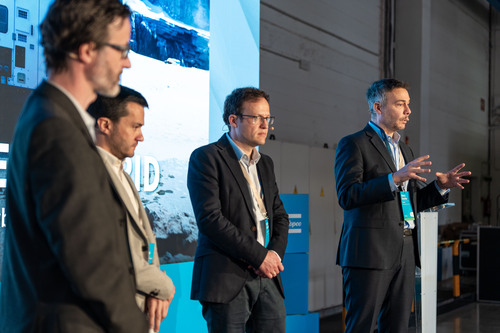
Marco Gravina (right) explains the key benefits of the QHS Hybrid generator..
Atlas Copco’s case for launching its new hybrid generator is rooted in a simple but powerful reality: the world’s energy demands are changing, and traditional diesel-only solutions are no longer fit for purpose in many applications. As highlighted during the presentation, the average load on generators today is just 15%, meaning that conventional units are frequently oversized and inefficient, which translates directly into wasted fuel, unnecessary emissions and increased operating costs.
The scale of the opportunity is enormous. In Europe alone, by Atlas Copco’s estimation, more than 200,000 generators under 200 kVA are currently in operation, representing 92% of the market. Replace those with hybrid solutions, and the potential impact becomes staggering – up to 3200 million litres of diesel could be saved annually.
Against this backdrop, Atlas Copco’s timing appears deliberate. As one speaker put it succinctly: “The main reason to release a hybrid now is because we are ready”.
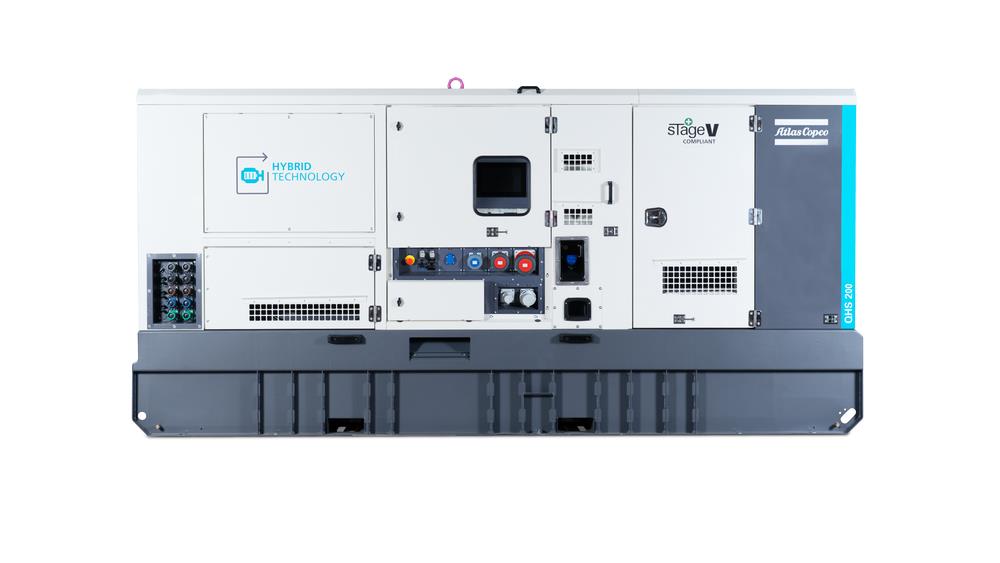
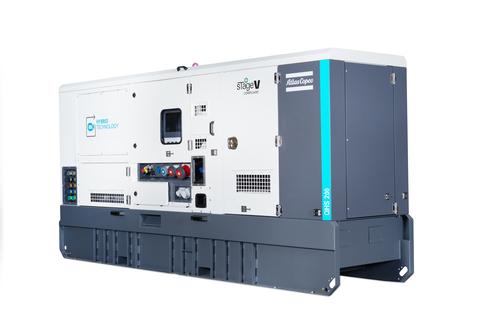
The company’s response is the new QHS Integrated Hybrid Generator range. The concept is straightforward but powerful: a system that combines diesel and battery technology into a single, all-in-one canopy unit, reducing fuel consumption and CO2 emissions while supporting fast installation, autonomous operation and high utilisation.
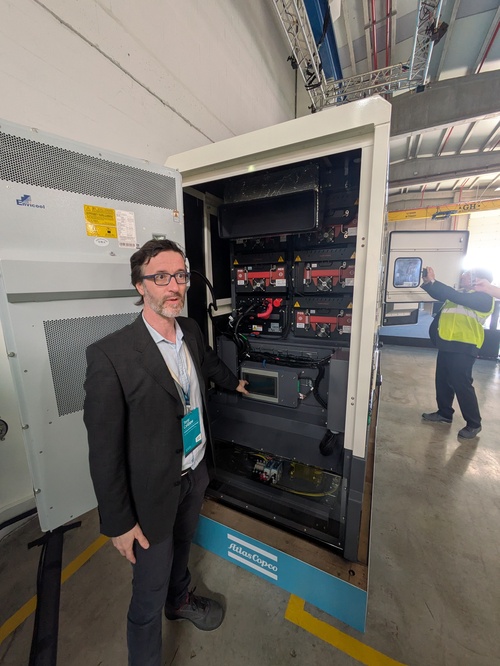
The battery component is explained by Divisional Sales & Marketing Manager, Tony Calippe.
Atlas Copco’s innovation is to bring everything together. As one presenter explained during the event, the new unit “integrates the diesel engine, battery technology, power electronics and intelligent energy management into one compact unit”. The result is a machine that is not only more efficient, but is dramatically easier to deploy.
The headline figures are compelling. According to Atlas Copco, the integrated hybrid generators can deliver up to 80% fuel savings, reduce CO2 emissions by up to 80%, and cut engine runtime by more than 95%, representing not incremental improvements but a fundamental shift in performance.
The presentation reinforced this with real-world application examples. In crane operations, for instance, annual fuel consumption can drop from 25,000 litres to just 4,500 litres, while CO2 emissions fall from 78 tonnes to 14 tonnes. Equally significant is the impact on maintenance. By reducing engine runtime so dramatically, service intervals can be extended from around 600 hours to over 3,000 hours, delivering substantial cost savings and improved asset longevity.
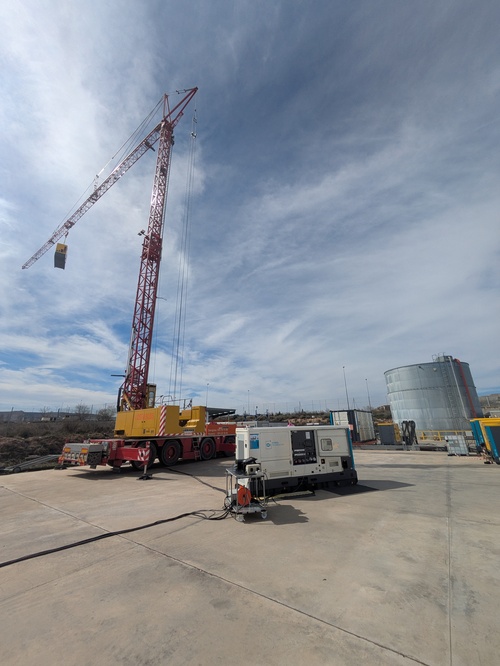
The QHS Hybrid generator is put to test in a typical site scenario.
Central to the system is Atlas Copco’s new ‘ECOController’, which acts as the heart of the system. This advanced energy management software automatically selects the most efficient power source at any given moment, seamlessly switching between battery and engine operation. As explained and convincingly demonstrated, it “prioritises supplying power to the load and then uses any surplus energy to charge the battery, ensuring efficient operations at all times”. During the presentation, this capability was framed as transformative, with the system not only controlling the machine but actively optimising it by selecting the most efficient source, adaptive to the load.
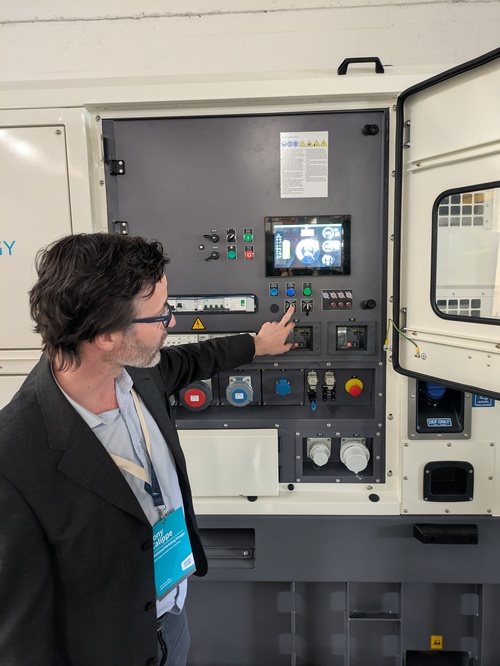
The new ECOcontroller is the brains of the QHS system - democratically designed so that almost anybody can use it!
Perhaps the most striking theme throughout the launch was simplicity. Hybrid power systems have existed for years, but their complexity has limited widespread adoption. The company’s goal is to change that. As Atlas Copco Power and Flow division President Marco Gravina put it, the new generator makes hybrid technology “democratic – everybody can use it”.
This is achieved through features such as one-click start/stop operation, fully autonomous running modes, minimal training requirements and an integrated design that eliminates external connections. Ease of operation sits firmly at the heart of the concept, with a simplified interface and fully autonomous operating mode allowing the QHS generators to adapt to changing load profiles without user intervention. For hire companies in particular, this simplicity is crucial, reducing training costs, speeding up deployment and ensuring consistent performance across diverse job sites.
Atlas Copco has clearly designed the QHS range with hire fleets in mind. Features such as multiple socket options, terminal boards, external fuel connections and FleetLink telemetry for remote monitoring, diagnostics and proactive fleet management are all geared towards maximising uptime and operational efficiency. As Divisional Sales & Marketing Manager Tony Calippe noted, the aim is to make hybrid power “easier to deploy, easier to operate and easier to rent”.
Sturdy skids, a lifting eye and fork pockets allow for easy manoeuvring.
Sustainability was a recurring theme throughout the Zaragoza event, but importantly, it was presented not as an abstract goal, but as a measurable outcome. Atlas Copco has already demonstrated significant impact through its hybrid and energy storage solutions, achieving savings equivalent to millions of litres of diesel and substantial CO2 reductions. The new integrated hybrid generator builds on this foundation.
As Portable Power and Flow Product Manager Sergio Salvador emphasised: “customers still need solutions that work in the real world… our new QHS Integrated Hybrid Generators are designed to help fleets deliver lower emissions and lower fuel consumption without sacrificing uptime, simplicity or transport efficiency”.
Flying home from Zaragoza, one thing was clear: Atlas Copco is not just responding to change, it is actively shaping it. By combining proven technologies - diesel engines, battery storage and advanced control systems – into a single, integrated solution, the company has addressed one of the biggest barriers to hybrid adoption – complexity.
The result is a product that delivers meaningful environmental benefits, significant cost savings, and operational simplicity in equal measure. As Marco Gravina emphasised, the ambition is clear: to become “the most trusted partner for demanding applications”.
With the launch of the QHS Hybrid Generator, Atlas Copco has taken a decisive step towards that goal and, in doing so, may well have redefined the future of portable power.