INDUSTRY NEWS
Astley Hire - establishing a northern niche
10:34 AM,
April 14, 2026
SHARE
Astley Hire has carved out an unusual place in the rental sector by serving clients in food manufacture and warehousing, and with a keen emphasis on professional training and some unusual professional standards…
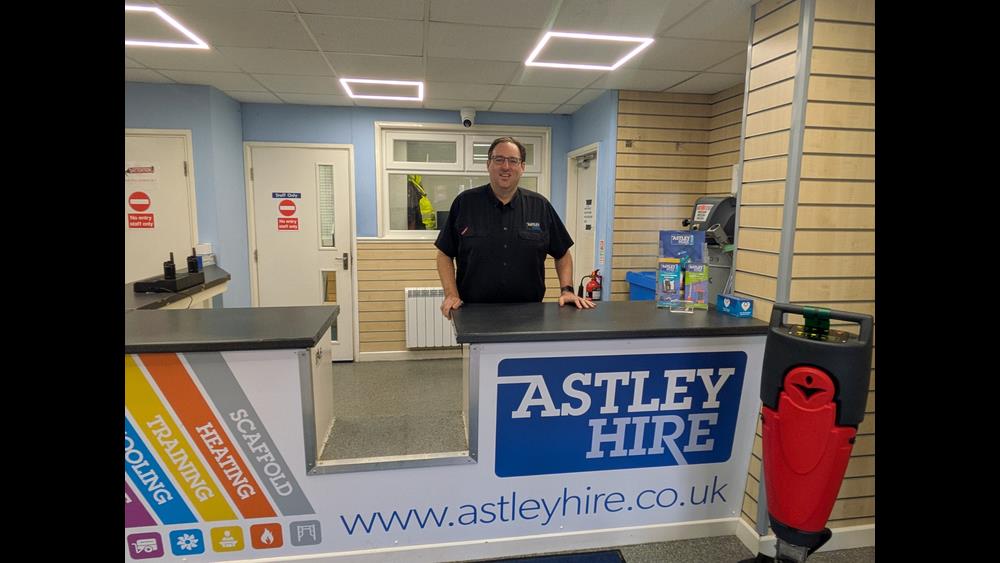
Spend any time in the UK’s plant and tool hire sector and a pattern quickly emerges – generalists tend to dominate. Depots stocked with everything from cement mixers to mini diggers, serving a revolving cast of builders and contractors. Greater Manchester-based Astley Hire has taken a different road, meanwhile – one that, as General Manager Martin Doran (pictured) puts it, often means “going right when everyone else goes left.”
That contrarian instinct has shaped the company’s journey from its family-based beginnings to a specialist provider serving food manufacturers and warehousing operators across the North West. It’s a story rooted in pragmatism, sharpened by opportunity and sustained by a willingness to do things differently.
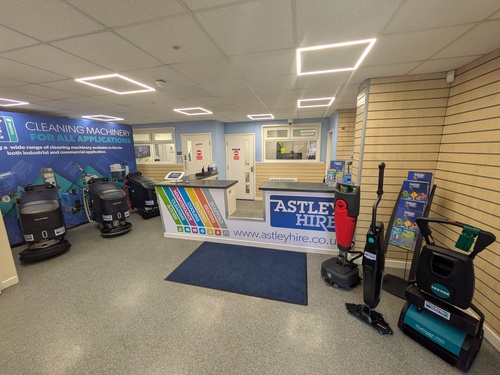
The Astley hire desk is neatly arranged, although walk-in customers are in the minority.
From kitchen table to specialist hire
The Astley Hire story begins at the kitchen table. Founded over 60 years ago by Cyril and Mildred Dorricott, the company started almost by accident. Cyril, then working at local hire firm, noticed a gap – customers kept asking for water pumps, but his employer didn’t supply them. So, Cyril and Mildred began sourcing and hiring them out themselves, repairing them at home and gradually building a customer base.
What followed was a familiar trajectory: a small local shop, then expansion into general tool hire – the company had several small depots by this point. At one stage, customers could pick up a cement mixer and their groceries in the same visit – a reflection of the business’s deep roots in its community.
But while many firms might have remained generalists, Astley Hire evolved. The second Dorricott generation, sons Stephen and Michael, expanded the business locally, and later consolidation brought operations under one roof at its current 14,000sqft site. When Martin joined eight years ago, he stepped into a company already shifting direction, and helped push that transformation further.
“I kind of advertised myself as their retirement plan,” he says of the founding family’s successors. Today, Stephen and Michael Dorricott remain involved at a strategic level, while Martin oversees day-to-day operations and long-term direction.
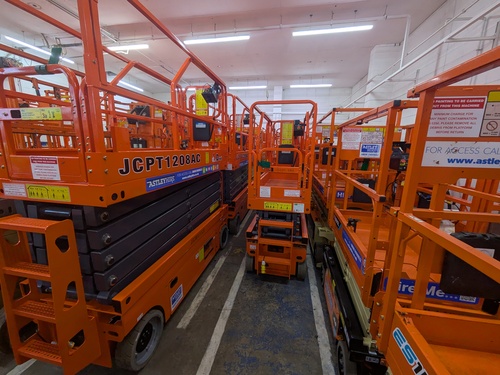
Astley Hire keeps a broad fleet of low level access products, all maintained in optimal condition.
Choosing a different customer
The real differentiator for Astley Hire lies in its customer base. Rather than chasing the broad construction market, the company focused on a narrower, less crowded segment: food manufacturing and warehousing.
The logic was simple. The North West has a dense concentration of food production facilities, and these sites have highly specific needs – cleanliness, compliance and reliability among them. Where others saw complexity, Astley Hire saw opportunity. “We’ve kind of gone, instead of chasing 90% of customers, we’ll just chase these 10% really well,” Martin explains.
That decision has shaped everything from the company’s fleet to its processes. Powered access equipment is configured for tight indoor environments. Cleaning machinery – particularly floor cleaners and sweepers – forms a significant part of the fleet. Cooling equipment is deployed to maintain controlled environments in temperature-sensitive operations.
Equipment with a purpose
Walk through Astley Hire’s depot and the emphasis on specialisation is clear. Around half of the business is powered access – scissor lifts, compact booms and platforms designed for maintenance work at height inside factories. Cleaning equipment accounts for another quarter, with cooling systems and smaller equipment making up the remainder.
The choice of fleet isn’t arbitrary. Food manufacturing sites demand immaculate conditions, and that extends to the machinery used within them. “You can’t send a rust bucket into a food store,” Martin says bluntly.
That requirement has driven a culture of meticulous maintenance. Machines are not only kept operational but presented to a high standard. Cleaning equipment, in particular, undergoes rigorous servicing cycles, with six-month inspections helping to prevent breakdowns and maintain hygiene standards.
Cooling units are stripped down and deep-cleaned between seasons. Access platforms are maintained to ensure they remain suitable for sensitive environments. It’s a level of care that goes beyond typical hire expectations.
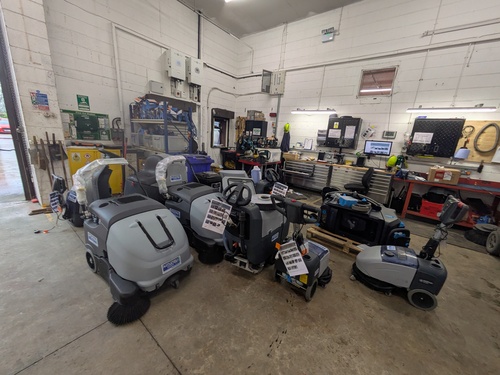
Floor cleaning machinery is prepared to the exacting standards required by Astley Hire's unique customers.
The HACCP advantage
Central to Astley Hire’s proposition is its adoption of ‘HACCP’ – Hazard Analysis and Critical Control Point – a standard more commonly associated with food production than equipment hire.
The company is one of the few in its sector to implement HACCP processes, a move driven directly by customer demand. Food manufacturers needed assurance that hired equipment would not introduce contaminants into their operations.
Astley Hire responded by mapping out risks and implementing control measures across its processes. The result is a system that governs everything from cleaning protocols to documentation and audits. “It’s about controlling any contaminant,” Martin explains. “From the machines, from the people, from anything going into that environment.”
The payoff is significant. Even where clients don’t explicitly require HACCP, the accreditation signals a level of professionalism and care that sets Astley Hire apart. It has become a powerful differentiator in a competitive market.
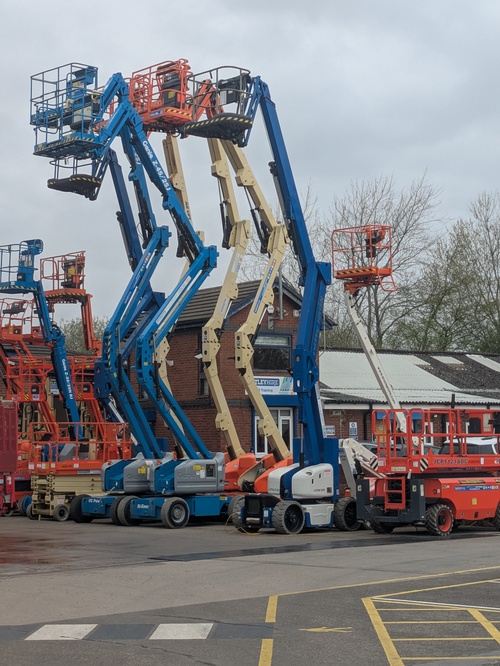
With platforms elevated, Astley Hire makes a strong impression from the street.
Training and capability
Supporting this specialist offering is a well-developed training division. Operating as a standalone part of the business, it delivers courses such as IPAF and PASMA to both internal staff and external customers.
With dedicated classrooms and instructors, the training arm processes dozens of candidates each week. It ensures that staff understand not just how to operate equipment, but the environments in which it is used. Even employees who don’t regularly operate machinery are trained to appreciate its role. “It helps them understand what goes into it,” Martin notes.
This emphasis on knowledge extends to customers, particularly supervisors in cleaning operations, who are trained to manage equipment effectively in high-turnover environments.
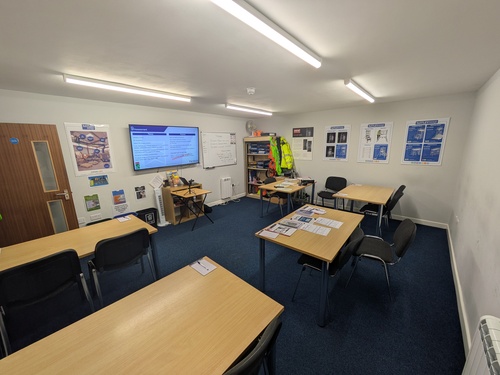
The Astley Hire training centre is well appointed.
Green ambitions
Long before sustainability became a buzzword, Astley Hire’s leadership had an interest in environmental responsibility. That ethos has translated into a range of initiatives, from ISO 14001 accreditation to carbon measurement and offsetting.
The company has achieved PAS 2060 carbon neutrality and earned a silver rating from EcoVadis, reflecting its broader ESG performance. Solar panels, electric company cars and alternative fuels such as HVO are all part of the mix.
Martin is pragmatic about the challenges. Heavy vehicles remain difficult to electrify, and emerging technologies such as hydrogen are not yet fully viable. But the direction of travel is clear. “It’s about measuring it, reducing it, and then offsetting what you can’t,” he says.
The heavens opened on the day of our visit, but this was the view from the workshop.
Weathering the market
Like the wider industry, Astley Hire has not been immune to economic uncertainty. Fluctuating demand, political shifts and rising costs have created a challenging environment.
Yet the company’s niche focus has provided some resilience. During the pandemic, its food manufacturing clients continued operating, allowing Astley Hire to remain open and maintain revenue streams through long-term hire agreements.
Even so, Martin acknowledges that the current climate requires effort. “It feels like you’re running on sand,” he says—progress is possible, but harder won.
Looking ahead
So, what comes next for Astley Hire?
The strategy remains consistent: deepen specialisation rather than broaden scope. There is potential to expand within existing sectors – more cleaning equipment, more long-term contracts and stronger relationships with industrial cleaning firms. At the same time, the company continues to refine its operations, investing in training, sustainability and fleet quality. There’s also an awareness that diversification, carefully managed, can provide stability.
What’s clear is that Astley Hire has no intention of becoming just another generalist hire company. “We don’t try and advertise ourselves as the master of everything,” Martin says. “We’d rather be really good at what we do.”
In an industry often defined by scale and breadth, this focus may be its greatest strength.

.jpg)